Every family-owned enterprise needs good advisers. The world is simply too complex to navigate alone when you are also managing significant family wealth or a family business.
Choosing the right advisers, however, is an art in itself. Who can you trust? Who has the right expertise, and how do you ensure that the deciding factor is not simply a long-standing family relationship, but genuine expertise and skill? Do you opt for a trusted adviser who can support the family across a wide range of situations, or a specialist brought in for a specific challenge?
If you are facing a business exit, approaching a generational transition, or preparing to launch a family office or foundation, there is also a natural opportunity to ask whether you have the right people in place.
Three criteria for selecting the right advisers
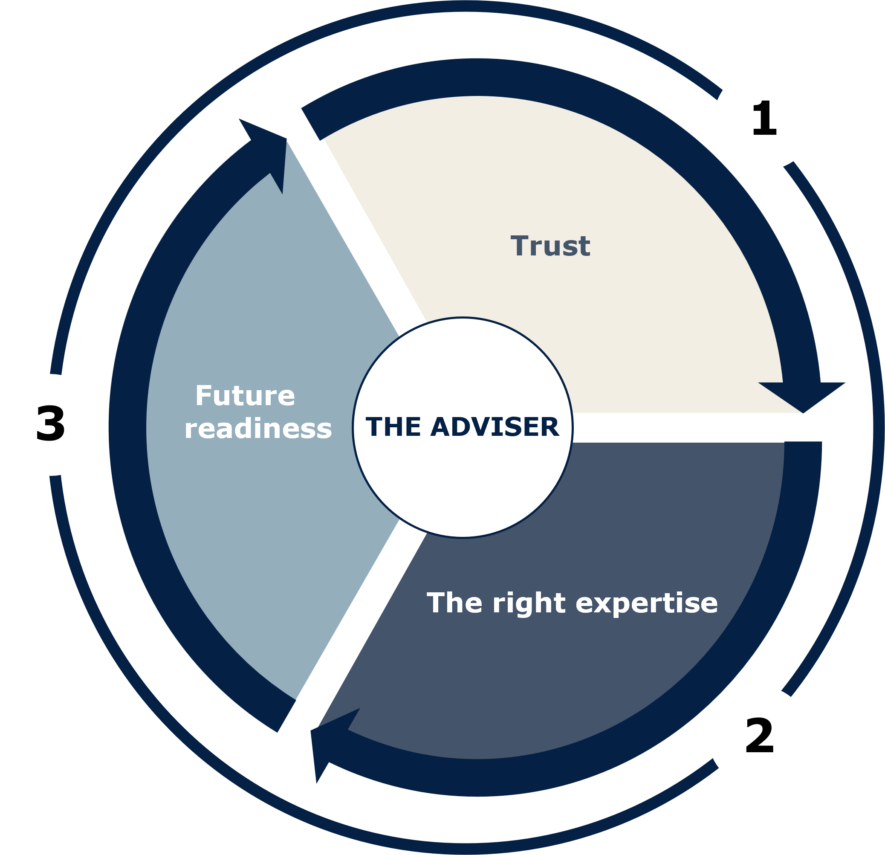
As the model shows, focusing on these three criteria will put you in a strong position when choosing advisers:
Trust
This criterion comes first because surrounding yourself with people you genuinely like is both a privilege and a necessity. Your adviser should not be your closest friend, but they should be someone whose values and outlook you share. If you have no genuine desire to listen to that person or spend time with them, you are unlikely to act on their advice.
But trust is not just about chemistry or a comfortable dynamic. It develops when an adviser is perceived as professionally credible, personally reliable, and able to create a space in which the family can speak openly. It also requires that the adviser does not make the relationship about themselves. A good adviser does not use the family’s complexity to make themselves indispensable but help the family become wiser and better equipped to make their own decisions.
The right expertise
There is no shortage of skilled advisers with sound expertise and strong credentials. They may be highly knowledgeable in their field and may have served on your board or advised you for many years, but is their expertise still what you need right now? As an owner, you need access to AI expertise, global risk specialists, media advisers, strategy consultants and geopolitical experts. Not all these people need seats on your board, but you should know where to find them at short notice, and you need trusted advisers who recognise the limits of their own expertise and know when to bring in others.
An adviser may be an excellent tax specialist, lawyer, investment adviser, communications consultant or board-level professional without necessarily being the right choice for the phase your ownership is entering.
Beyond their own field, an adviser must be able to see the full picture of your ownership. In family ownership, legal, financial, governance, investment, family dynamics, communication and identity dimensions are all closely intertwined. An adviser who only sees their own area of expertise risks giving a perfectly correct answer to a far too narrow question.
Future readiness
The third criterion is future readiness. Most owners choose advisers based on what they need today, but laying the foundations for the next generation of ownership means finding someone who can also help you prepare for challenges you cannot yet fully see.
Agentic AI, deepfakes, cyberattacks on critical infrastructure, technological dependency, geopolitical fragmentation, hybrid warfare, resource scarcity, energy security, physical climate risks, regulatory acceleration, talent shortages and shifting expectations from the next generation can, in an extremely short space of time, transform the conditions of ownership. Your adviser therefore needs to do more than operate within familiar frameworks; they must also help the family think in terms of scenarios, resilience and renewal. Even if that renewal means they are no longer the right person in three to five years’ time. You must also be able to structure your advisory team in a way that allows for change, bringing in new expertise as your ownership evolves. Continuity and renewal are standard requirements for any board, yet this is a topic that rarely gets the attention it deserves. A truly forward-looking adviser knows when to step aside.
Look out for our next newsletter or get in touch for a no-obligation conversation about what lies ahead for you as an owner and how to ensure you have the right people in place.
If you have received this article from a colleague or acquaintance and would like to receive future newsletters directly, you can sign up here.