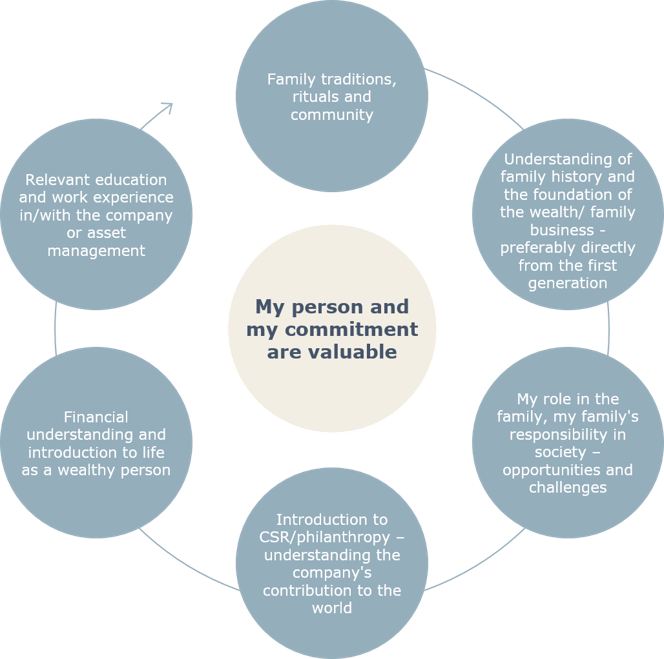

One of the educational slogans of the 1980s was: Have you talked to your child today? As a parent of one or more children who will become wealthy, there are several conversations to be had. It can be difficult to decide when and how best to start preparing the next generation for the obligations and privileges ahead. That’s why this article looks at how to talk to your child about their wealth – today and every day.
When managing the family fortune, you don’t have to compete with your siblings for executive roles in the company. On the contrary, you can develop the community by investing in areas that interest you and make you happy. By setting up regular meetings among owners, the ownership becomes more like a real job, which can be enriching and satisfying.
Facing the Responsibility
A good generational handover is a well-planned process and a smooth transition in terms of both work and identity. The process can, in reality, take decades, with the next generation going from being the children of a wealthy family, more or less aware of their particular financial situation, to adult, responsible owners. In some families, the size and importance of wealth are downplayed, and the young person may be surprised when they realise the extent of their wealth – and the responsibilities that come with it. Our recommendation will often be to make the children aware early on and frame it as positively as possible, focusing on the opportunities, benefits, and responsibilities of ownership.
To create a positive perception of ownership, it is important that the young person’s lot in life is also seen from their perspective. They are both privileged and fortunate in terms of their financial situation, but they are also placed in a situation that is not of their own choosing. This brings with it a number of aspects that make their lives significantly different from those of their peers.
The Next Generation Has Their Own Challenges
- They may feel they have to live up to the family legends that have created the wealth. And this can leave them feeling pressured to fulfil expectations in terms of choice of education, leisure time interests, and academic performance
- They have to navigate socialising with friends with different financial means. They have to protect the family’s name in the press and as such have to be careful, for example, with how they use social media
- They will often develop a radar, and perhaps even put up a wall, to protect themselves from “friendships” based on interest in their financial situation/family name
- They need to motivate themselves to pursue an education and consider careers even though they don’t have to work
- They have to be aware of their own and their family’s security
- They need to make sense of their wealth and decide how they will act as owners and how they will use their finances in a way that makes sense for them personally, but also for their family
This is quite a lot to think about when they are already struggling with the normal development of their identity as teenagers and young adults.
Our recommendation will always be honest talk and a gradual introduction to the ownership. In this process, young people can better plan their educational and professional choices and gradually adjust to their life situation.