Have you Discussed Main Character vs. Supporting Roles Within your Family Ownership?
In major Hollywood productions, casting directors receive far too little recognition for their work. Could you imagine anyone other than Al Pacino playing Don Corleone in The Godfather? Or anyone but Julia Roberts as Vivian in Pretty Woman?
In family ownership, roles must also be cast carefully. While a young actor would rarely turn down an exciting leading role, not everyone in a family is keen to take on responsibility or step into the spotlight in a ‘leading owner’ role. As a founder or member of the now generation, you may have made detailed plans for how the next generation should be involved. You might also have pictured them serving on boards, working in the business, or participating in the family foundation. But until you have asked them what they want, there is no actual plan.
Clarifying expectations before casting roles
Conversations about roles in family ownership are rarely straightforward. There is almost always an undercurrent of expectations, hopes, duty and a sense of responsibility on all sides. The next generation often feels that once they have agreed to become more actively involved, there is no back door out. If it later proves to be the wrong decision, stepping away can be difficult.
From the founder’s perspective, it can be equally challenging to assess whether a wish to be involved stems from genuine commitment and a desire to create value, or from a sense of obligation. For that reason, it helps to have a clear structure to rely on when these discussions take place. The model below can serve as a practical tool in the casting process.
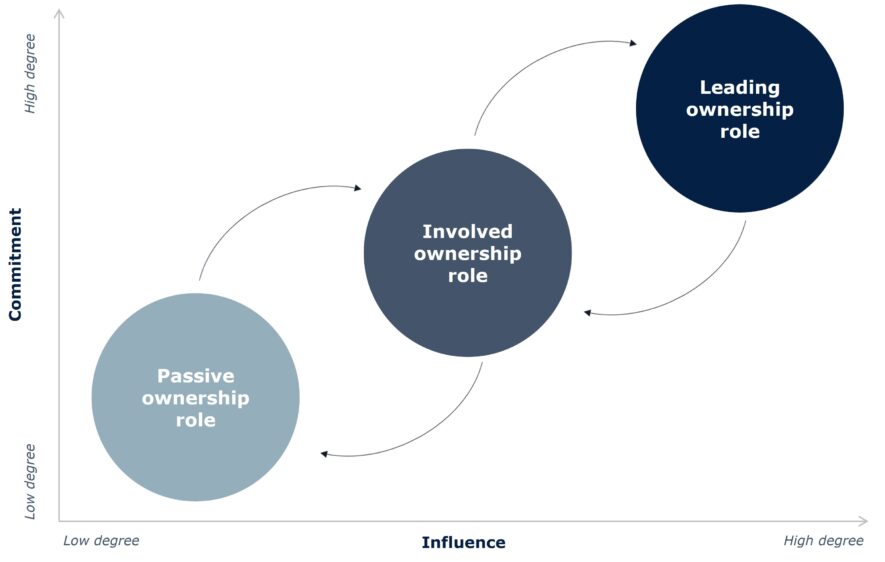
In the passive owner role, engagement in the ownership is low. Little or no time is spent on meetings, and the level of information is limited. Life largely unfolds outside the ownership and is mainly experienced through its financial benefits or through stories shared by more active family members at gatherings. There may be some curiosity, but influence rests with parents, siblings or cousins in more active roles.
In many family ownership structures, shares are transferred at an early age, and some individuals may not even be fully aware that they are owners. As a result, the youngest generation often finds itself in a passive role until the founder or current generation opens the door to greater involvement, for example in connection with generational transition.
The involved owner role represents a middle position, with a moderate level of engagement. Owners in this role take part in the ownership while also balancing work, a career, or kids. An involved owner might, for example, sit on the board as an observer or ordinary member. The role may also include specific responsibilities such as organising family gatherings, facilitating owners’ forums, or contributing to HR-related initiatives within the family office.
An involved owner may be growing into the role while completing their education or working elsewhere. Over time, the role can evolve in either direction. At a later stage, one may choose to either step back or move towards a leading owner role.
In the leading owner role, full responsibility for guiding the ownership rests with one individual. This may be because they have the strongest motivation, the right capabilities, or simply the necessary time. It may be that other siblings did not want the role. Or it may stem from a deep commitment to carrying the family’s legacy forward. Whatever the motivation, the role is a full-time responsibility – not necessarily measured in hours, but in the priority, it takes over other opportunities. The leading owner sets the direction of the ownership and may serve as CEO, chair of the board, or hold a comparable position. At the same time, the role involves acting as a key communicator within the family and taking active responsibility for stewarding the family’s shared legacy. It is a meaningful and central role, but it can also be demanding and, at times, lonely.
Every family ownership needs at least one leading individual. Without this role, the ownership risks being shaped primarily by external advisers.
While the next generation will typically move through the roles in the order indicated by the arrows above the circles, the founder or incumbent generation will often move in the opposite direction, as shown beneath them in the model. When this transition works well, it creates a sustainable ownership model over time.
For the sake of both the family’s wealth management and its family community, it is essential that roles are clearly defined and expectations carefully aligned. Ideally, this should be done in great detail, with clarity regarding titles, remuneration, development plans and related matters.
Please feel free to contact us for an informal discussion about how you might approach these conversations. You can also read more about strategic generational transition here and here.