“Instead of ‘going public’, you could say we’re ‘going purpose’,” said Patagonia founder and billionaire Yvon Chouinard when he announced that 98% of the company’s shares had been transferred to the Holdfast Collective, to be used in the fight against the climate crisis. The Chouinard family's action is one of the most significant examples of purpose-driven wealth and family ownership in recent times. However, one need not give away their fortune to experience the benefits of a clearly defined purpose. In this article, we explore how your family can work with purpose in your ownership structure.
The Purpose of Purpose
At its most basic, purpose should be understood as the reason a given organisation exists. Purpose should be tangible enough to guide strategic decisions, behaviours, and culture, while also being motivating, engaging, and creating meaning and a unique culture for the organisation—or the family ownership.
Ownership can sometimes seem abstract to family members, especially if there is no longer a concrete family business in which to find identity or set goals. Developing a strong purpose rooted in the family’s history, culture, identity, and interests creates engagement and meaning for the family on a deeper level than wealth management and accumulation alone can offer.
Whereas wealth accumulation is largely about creating financial capital, purpose-driven family ownership is about creating a richer life.
Purpose Sets Direction for the Family Office
Investments, level of service, and activities in a family office are as unique as the family itself. However, with a clear purpose, everyone works toward the same goal and in the same direction.
The family office gains a clear strategy and clear success criteria for its operations and can thereby even better fulfil the family’s wishes, dreams, and goals across generations with a long-term perspective. The same applies to the family’s other advisers, who assist with, for example, succession planning, strategy, tax planning, wills, and so on.
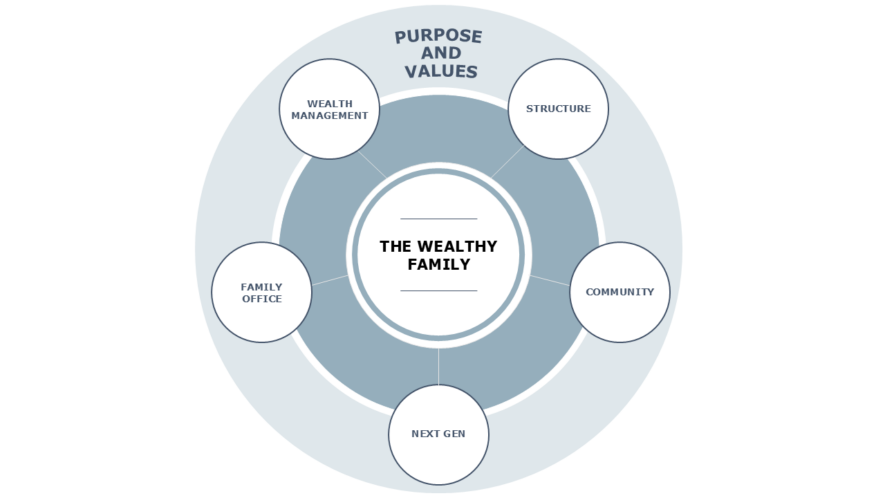
Purpose provides direction for all aspects of active family ownership
Case Example
A relevant example might be a family—we can call them the Hansen family—who wishes to make an impact in the field of nature and climate. Their purpose might read:
In the Hansen family, we wish to use our position and resources to live a life in which we, generation after generation, strive to leave the planet in a better state than when we arrived. This goal should be reflected in our investments, philanthropy, and in our family community and development.
Note that purpose is broader and deeper than a purely philanthropic effort. With this purpose, the family would need to review their investments to ensure that they are in fact doing more good than harm. They would need to formulate an active exclusion list, making joint decisions not to invest in industries that harm the climate. They would need to ensure that private equity, venture capital, and infrastructure or securities investments come with clear climate policies, and they would need to consider using parts of their fortune to invest in, for example, forests, biodiversity, agroforestry, or similar initiatives.
With regard to the family community and development, they would need to plan family activities that promote learning and the development of knowledge and attitudes about the climate crisis and its solutions. They must educate and raise the next generation to support the family’s mission statement and create a sense of community around the effort. They would need to attract experts in the field to the board and the family office and maintain direction for any philanthropic efforts so that everything aligns with greater meaning.
The Outcome is 4 x R
So what is the result of this streamlined and far-reaching work to develop and implement the family’s purpose?
Purpose-driven family ownership delivers what can be described as 4 x R:
- A roadmap for family members, the family office, and advisers
- Resilience in the family’s cohesion and shared values
- Roles in ownership for both younger and older generations, in-laws, and other family members who wish to contribute to ownership but may not have the skills or interest in, for example, investing
- Relationships outside the family. It can feel unfulfilling not to have a career or a clear path in working life, but a strong purpose provides access to networks, opportunities to build relationships, and a structure for one’s professional life
Professor Victor Strecher has studied purpose-driven living throughout his career and described the benefits of living with purpose as follows:
So let’s imagine a drug that was shown to add years to your life; reduce the risk of heart attack and stroke; cut your risk of Alzheimer’s disease by more than half; help you relax during the day and sleep better at night; double your chances of staying drug- and alcohol-free after treatment; activate your natural killer cells; diminish your inflammatory cells; increase your good cholesterol; and repair your DNA. The inventors of the drug would receive Nobel Prizes and have institutes named for them! But it’s not a drug. It’s purpose.
You can already take the first steps by discussing the following questions within the family:
- What is meaningful, exciting, and motivating for us to work on?
- Who and what do we want to create value for?
- Are there any milestones in the family’s history that have had great significance and should be incorporated into the purpose?